

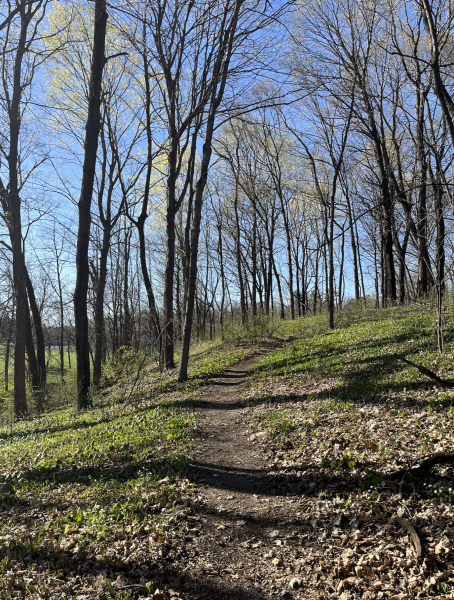
If you branch off of the paved path at Postage Stamp Prairie in the Upper Arb, you may find a single-track trail with fantastic views of early spring wildflowers. The trail runs for a few hundred meters along the hill overlooking Bell Field, and is nestled between the paved path and Spring Creek. Though it is absent from most maps of the Arb, the trail is well-known among nature-lovers seeking a first peek at emerging plant life after a cold winter.
The trail is in Stork Forest, which was planted in the 1930s and is one of the earliest native-forest restorations in North America. Woodland restoration involved not only planting trees, but also shrubs and flowers. The moist soil here has allowed many spring ephemerals to thrive. If you have a chance, look out for these wildflower species:
- Bloodroot (Sanguinaria canadensis): A true harbinger of spring in Minnesota, sometimes even emerging while snow is still on the ground. A deeply lobed, kidney-shaped leaf embraces a single white flower. The name refers to the red juice that bleeds from broken stems, leaves, and roots.
- White Trout Lily (Erythronium albidum): Like Bloodroot, one of the first woodland flowers to bloom in the spring. Tends to grow in large colonies. A single, nodding, white flower sits at the end of a stiff stalk up to 8 inches tall. Leaves can be recognized by their irregular mottling with purplish brown patches.
- Canadian Wild Ginger (Asarum canadense): Grows in large colonies. Each plant has a pair of heart-shaped basal leaves on stalks up to six inches long. A single, dark red flower lies on the ground at the base of the plant.
- Wood anemone (Anemone quinquefolia): Grows in thick mats, spreading via rhizomes. A single, one-inch flower arises from a whorl of leaves at the end of the stem. Often only a few flowers are seen among the leaves, as a single plant may take five years or longer to flower!
Source: Minnesota Wildflowers (minnesotawildflowers.info)
(Max Posner)