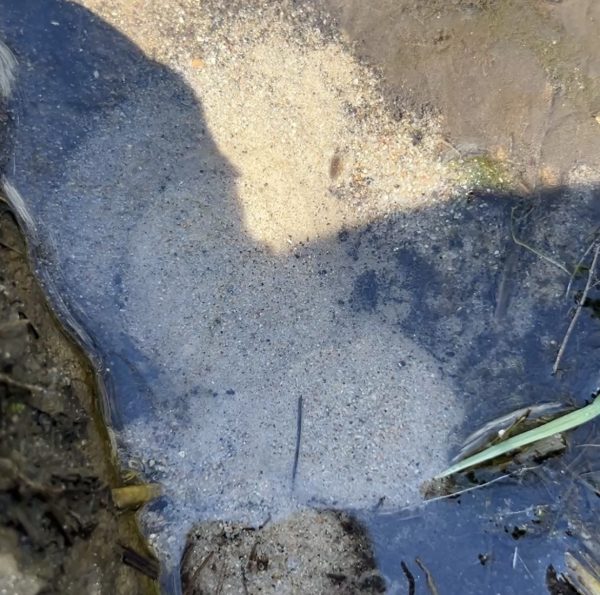

Have you ever wondered why Spring Creek is called Spring Creek? Flowing northwest through campus, Spring Creek has been a staple of campus for its entire existence. If you’ve ever dipped a toe in, you may have noticed that it can be fairly cold, even in the height of summer. This is because much of the water in Spring Creek comes from springs of the Jordan sandstone! There are many types of springs that exist in Minnesota, but those that exist within the creek are very special.
Springs occur when water trapped in geologic formations underground is under pressure and comes up through cracks in the overlying rock. Many of the springs in Spring Creek are known as sand boils. These are adorable spots where groundwater comes up to the creek bed and bubbles out in little patches. The action of water flowing through the sediment picks up lighter clay particles and washes them away, leaving grains of sand that bounce and dance around in the upwelling current. If you walk along the banks of Spring Creek, you should be able to find these lighter-colored patches of sand with sizes ranging from the palm of your hand to less than a finger’s breadth. Once you see one, you will see many more of these magical little features.
A fair question to ask would be how these springs got here. Originally, water flowed through the Jordan sandstone (~500 million years old) unimpeded, albeit under pressure of the overlying rocks. Then, around 10,000 years ago, kilometer-thick ice sheets extended to Northfield from the north and west. When they melted, the amount of water that flowed across the landscape was immense. Rivers, over 30 meters deep, carved the valley through which Spring Creek now flows, providing a topographic low for the springs to appear and within which the landscape continues to evolve.