
You’re likely familiar with parasites: organisms that live in or on another at the expense of the host. You might not be aware, however, that parasites can themselves get parasites, known as hyperparasites. Even hyperparasites can get parasites, with as many as four layers of parasitism! As with many things, it’s turtles (or, in this case, parasites) all the way down.
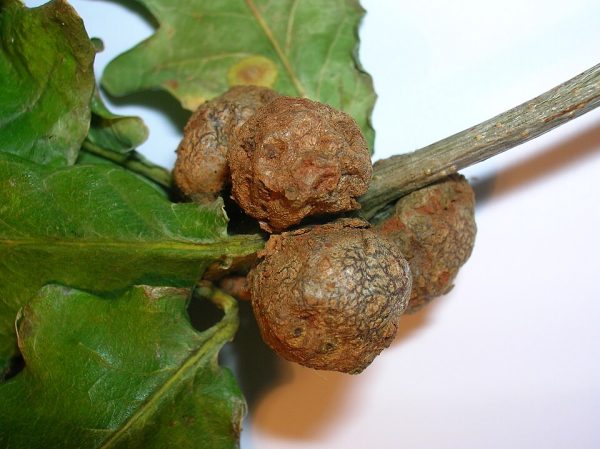
The arboretum is home to a number of parasites and hyperparasites. One of the most common is the gall wasp, which is really a family of wasps that lay eggs in plant tissues. These eggs release chemicals that induce the growth of a mass of plant matter, which the larvae feed on before pupating and emerging from the calls as adults. Galls, which can look like tumors growing on plants, can be found in a variety of species throughout the arboretum. Some gall wasps, including those in the arboretum, have their own hyperparasites. These wasps pierce the galls with organs called ovipositors, which have evolved to have a specific length that can reach the larva inside the gall, lay eggs inside it, and eat it from the inside out before emerging as an adult.
Of the hyperparasites that might exist in the arboretum, the Trigonalidae are some of the most remarkable. Individuals from this family of parasitic wasps are extremely rare but found all over the world. Little is known about them, but what is known is improbable edging on absurdity. They lay eggs in leaves, hoping a caterpillar will eat the leaf and ingest the eggs without chewing them too much. Then the eggs emerge inside it and, instead of consuming the caterpillar, eat whatever other parasite eggs are in the caterpillar, including their siblings. Otherwise, they wait and hope that caterpillar gets taken to a colony of vespid wasps, which tear it apart and feed it (and the eggs) to their hungry larvae, which the Trigonalidae consume from the inside. If the caterpillar is not attacked by other parasites or fed to these wasps, the larvae cannot develop. The world of hyperparasites is truly improbable!