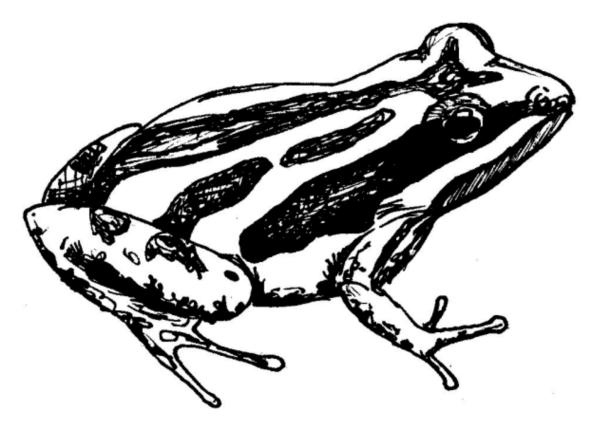

It’s mating season! In the spring, male frogs and toads begin to search for mates. They call repeatedly, often throughout the day, though particularly at dusk, attempting to attract females. The Arboretum is home to multiple frog and toad species. In the early spring, you might hear Western Chorus Frogs (Pseudacris triseriata), Wood Frogs (Rana sylvatica), and Northern Leopard Frogs (Rana pipiens). Towards the summer, the American Toad (Bufo americanus) begins to mate, along with Gray Treefrogs (Hyla versicolor), and then Bullfrogs (Rana catesbeiana) and Green Frogs (Rana clamitans). These species are all native to Minnesota, except for Bullfrogs, which are native to North America, but were likely introduced to Minnesota as pets. The timing of the mating season for different species varies largely by temperature preferences. Wood Frogs and Chorus Frogs breed the earliest because they can withstand freezing temperatures.
Once a male attracts a female, a mating ritual ensues called Amplexus. The female lays eggs, and the male attempts to deposit sperm onto the eggs as they are laid. This mating ritual generally lasts several hours to a couple of days. The eggs are laid in an amorphous mass called frogspawn, with dozens to thousands of eggs in a particular spawn, depending on the species. Each egg looks like a black speck surrounded by a jelly-like substance. Once the eggs are laid and fertilized, they hatch within a couple of weeks.
Each spring, Carleton’s Student Naturalists lead two frog and toad surveys. Participants visit wetland sites in the Arb, and listen for frog and toad calls. It is part of the broader Minnesota Statewide FrogWatch project (more info available here:
https://www.dnr.state.mn.us/volunteering/frogtoad_survey/index.html), a statewide citizen science survey resulting in a robust database of frog and toad populations. The first survey was conducted a few weeks ago, but any interested Carleton Students should keep an eye out for information about the next one!