
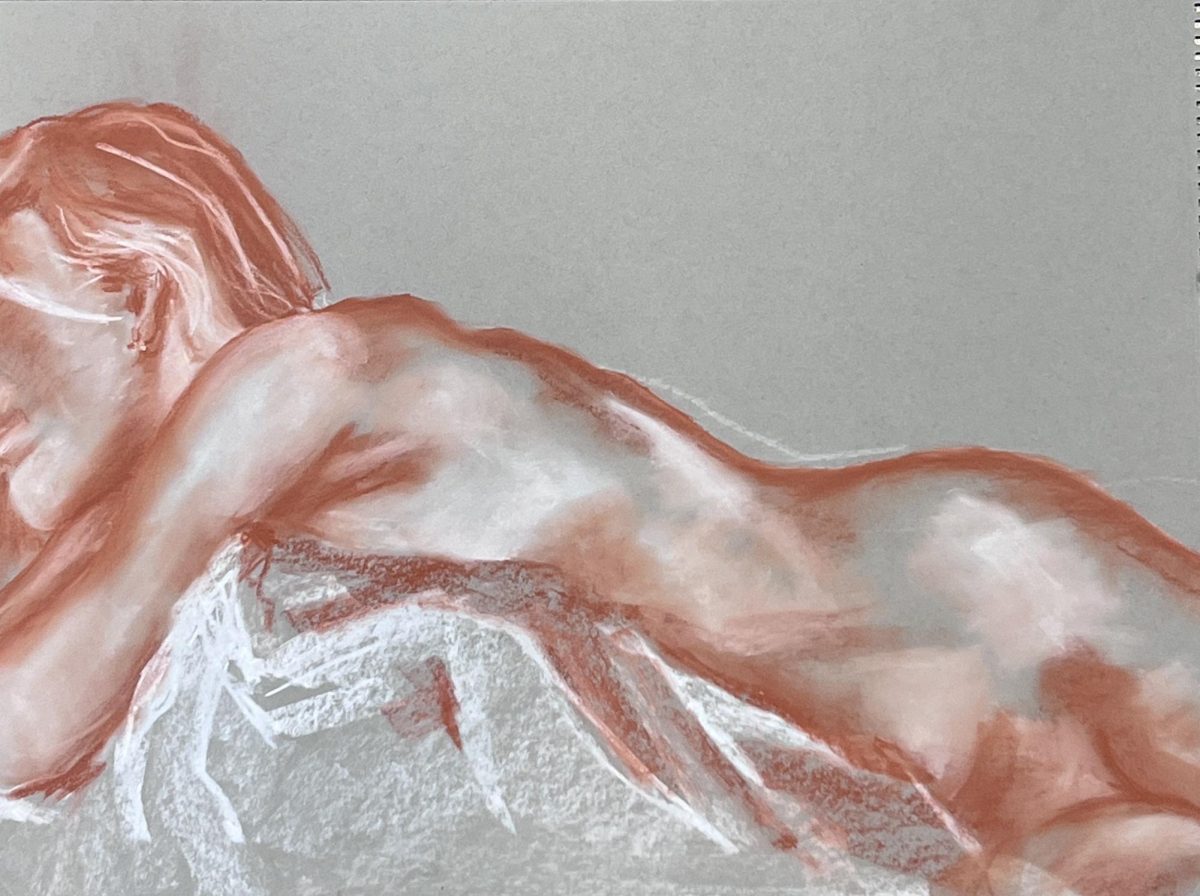
Every week, Carleton students serve as nude models for a variety of different Studio Art classes, including Observational Drawing and Life Drawing, which focus on the human figure as an important area of artistic inquiry. This process involves hiring students to come in as part of their work-study positions and model nude for both classes and weekly evening sessions supervised by other students.
Speaking about the importance of nude modeling as part of a holistic art practice, Visiting Studio Art Professor Soren Hope ’15 said, “One thing that I keep coming back to is… to draw the human figure, it puts the student in this tradition that gives you access to… the entire role of the nude figure in art history in a way that I feel you can’t access without having ever drawn a nude figure.” Elaborating further, they stated that “personally, it is an irreplaceable access point to the infinite mystery of being a person… to engage with the mystery of having a body and using your body to draw a body, it is to spend time with that infinite.”
In an interview with The Carletonian in 2023, Senior Lecturer in Arts Emeritus Dan Bruggeman spoke to the uniqueness of figure drawing as a practice: “In a contemporary world, I still think the figure is relevant. It’s been a vessel or a feature of the dominant narrative in every Western culture since the Greeks,” he said. “So somewhere in the representation of the human figure there’s something about what’s important in that moment, whether it’s the Greeks’ notion of figurative perfection or their use of narrative in all the complexities of humans that they were so great at representing…. Now, figure couldn’t be more relevant because the way artists are using it now embodies the conversations we have about gender, sexuality, race. Only the figure can really tell us about that.”
Using students as nude models, however, comes with its own set of challenges. Hope explained that, “If people were to ask, ‘Why not wear a bathing suit?’, part of my answer is formal and relates to continuity of line and value. The other part of my answer comes down to social contracts and constructs around modesty.”
Bruggeman distinguished the difference between nakedness and nudity in the context of modeling, saying, “Nakedness implies that someone is not willingly doing whatever it is that they’re doing, or there’s a privacy requirement, and nudity is, this person is standing up there and willingly allowing someone to draw them or photograph or work from them, and you have to get that balance right,”
When speaking to the models themselves, there seems to be a diversity of reasons for taking on the role. “I heard that the department had a hard time finding models, and I had attended the evening sessions in previous years. It felt like a good way to give back to the department and get a different experience of the model-artist relationship,” said one model, who asked to remain anonymous.
Another model, who also asked to remain anonymous, said that before becoming a model, their friend, who was already a model, encouraged them to attend some of the life drawing sessions to ‘get a feel’ for the role. They ultimately decided to model out of a sense of curiosity about being drawn by others.
Models described a range of challenges and surprises that came along with the role. “I wasn’t really expecting to learn more about myself, feeling more comfortable with who I am, and totally wasn’t expecting to feel any of those sorts of things. It was a nice surprise,” said one model.
Physical exertion is not the only obstacle that models face. Another model said, “I was surprised by how mental it is. I anticipated a physical challenge, and there is one often, but there are a lot of factors that one has to keep in mind for each pose. Did I already face this way? How is the light hitting my face? What material are they working with, subtractive or additive, do I want to create high or low contrast? I mean, I suppose these are optional considerations, but I try to provide a full-service experience.“
Models are sometimes asked to hold poses for up to 45 minutes to an hour at a time in both classes and evening sessions. They are provided with a variety of options for posing from chairs to arranging pillows on a raised platform so that students positioned all around them can draw them comfortably while the model is able to assume a more relaxed position for longer drawing sessions. Heaters in the room can be tuned to the model’s comfort level, and sliding covers on the windows in conjunction with the gridded lighting system above the models provide many different options for casting light onto the models to aid in the drawing process.
One model reported,”It’s a lot more physically taxing than I expected to hold poses for a long time. I also think it takes some intentionality to choose a healthy balance of realistic poses to hold and yet also [be in a pose that is] interesting to draw.”
Another said, “Sometimes the poses are just physically hard. 15 minutes of doing a weird smile like I did last week was really hard but it’s kind of like a fun challenge, and it’s kind of meditative trying to keep still for one pose for 15 minutes, in a hard way.”
Students are hired through the art department and paid the same wage as other student jobs under the current wage equality system, but this was not always the case. Hope noted, “When I was a student, when I first heard about student modeling, it was in the same breath that I heard it was time and a half pay, or double pay or whatever it was. The increased pay of it was a baseline recognition of the difficulty of modeling and the value of it.”
In their final thoughts on the modeling department at Carleton, Hope referred back to one of their mentors at Carleton, Professor Emeritus of Art Fred Hagstrom, who believed that “everything he ever drew was based in his background of figure drawing.”
Similarly, Bruggeman spoke to the fundamental human need to draw figuratively. “I still think that drawing is so fundamental to not just a person’s aspirations to be an artist, but also just to the impulse that we have to kind of look at something that we have, a body, and learn how to represent,” he said. “It kind of goes back to our earliest utterances as human beings, where we were demonstrating that we had a mind, and that we were looking at the world and contemplating it.”
When talking about how they would describe the role to the wider campus community, one model said, “I think it’s a great job if you’re not shy about being naked. The people are really nice, the space feels very inclusive and comfortable, and the people you get to meet through it are all great!”