
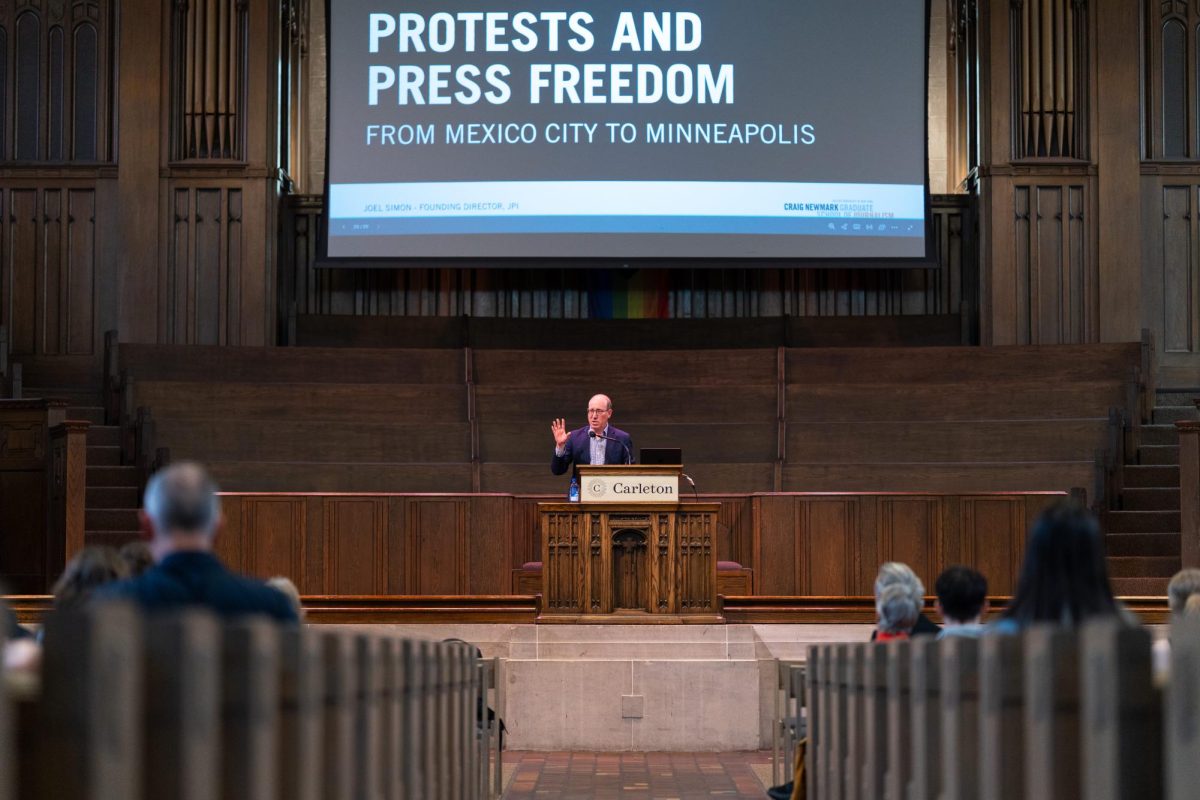
On Friday, April 17, Carleton College hosted Joel Simon, the founder of the Journalism Protection Initiative (JPI), for Convocation, the campus’s weekly lecture series. His talk, titled “Protests and Press Freedom: From Mexico City to Minneapolis,” discussed his perspective on modern-day threats to journalism and democratic rights.
Simon is currently the director of JPI at the Craig Newmark Graduate School of Journalism in New York City, where he leads efforts to research and develop tools that safeguard journalists and strengthen press freedom globally.
He began his career as a journalist in Guatemala in the early 1990s, where he covered the country’s civil conflict. Following this, he reported on political and social movements across the world while simultaneously advocating for the right of the press to safely cover these movements.
In addition to his college-wide talk, Simon joined four students at a breakfast hosted by the Political Science Department that morning. They spoke about the evolving field of journalism and its presence in contemporary society.
A large portion of his discussion with the students focused on the best ways in which people can consume media in an era of misinformation and polarization. Simon explained that part of the explanation for such a large social divide in news media is that “people factor in information based on the communities they are a part of.”
Olivia Gottlieb ’28 said, “Joel’s discussion made me reconsider how to determine that a news source is accurate and trustworthy. I realized that I trust a selection of news sources because other people have informed me that I should trust them.”
Simon also spoke about the “transformative” nature of journalism and how the field has “a lot of exciting reinvention happening.” Students reflected on new social media platforms that journalists have been using to their advantage to reach wider audiences, like Substack, as well as streaming platforms like Twitch and Noosphere.
When reflecting on this part of the discussion, Gottlieb felt conflicted by this less-traditional approach to journalism. “I think it is important to be cautious in consuming news through social media, which is a main vector in spreading misinformation, yet is also a helpful resource in reaching a wider audience.”
When asked how he personally navigates the evolving media landscape and specifically how he reads articles himself, Simon shared that he reads with “some level of skepticism every time.” He added that he finds the journalists themselves in every article, “I look at the human part of the job.”
The breakfast conversation was expanded upon during Simon’s Convocation talk. The main focus of his presentation was the evolving nature of the protection of the press in the United States, especially in recent months, regarding coverage of protests against U.S. Immigration and Customs Enforcement (ICE).
Simon reflected on his time in Latin America and the shift he’s felt worldwide since that era of his life, particularly in the U.S.
Amelia Hildebrandt ’27 was moved by his emphasis on the safety and protection of journalists, saying that “his photos of journalists being threatened and harmed during the ICE protests in Minneapolis were something that drew my attention, especially being from Minnesota.”
One of the main shifts that Simon highlighted was that the police force did not protect professional journalists who appropriately identified themselves, and, in fact, singled them out. Hildebrandt was shocked by how “even with the proper identifications and protections, they were still targeted.”
Additionally, Simon juxtaposed his own experience covering conflict and protests with those of himself and his colleagues in today’s political climate.
Alfred Montero, a professor of political science, added:“I am quite familiar with what happened in Mexico during the time that Joel Simon lived there and covered the stolen election of 1988 and the tumultuous events of 1994. He deserved to be on that stage. But that story contrasts fundamentally with what would happen today. I doubt any mainstream journalist would be welcomed like that in every demonstration.”
Simon discussed the danger of what happens, particularly what is lost, when the freedom of the press is left unprotected. He shared a video from 2023 when he was a Senior Visiting Fellow at the Knight First Amendment Institute, and in it he warned that “the next time there are large-scale protests, the pieces of fabric that are kind of holding this together may tear completely.”
As Gottlieb thought about what press freedom means to her and what might be lost, she stated that “journalism is a key avenue for individuals to feel empathy for others.” Simon cautioned against what he believes may happen if journalists are unable to safely cover events, especially social and political movements like the ICE protests. He argued that the “avenue” Gottlieb pointed out would then be destroyed.
Montero is currently teaching “The Global Crisis of Democracy,” a course addressing many issues, including the eradication of press freedoms. Montero reflected on Simon’s speech as well, saying that, “our society needs to think deeply about how the media environment has changed in ways that undermine our search for truth, for justice and for equity.”
Simon sees himself as a lifelong advocate for the protection of press freedom and sought to emphasize the attention that the issue needs now more than ever. He spoke about how journalists Don Lemon and Georgia Fort were targeted and arrested for covering a protest at Cities Church in St. Paul, a key example of how press freedom is currently absent in the U.S. His main argument was simple: “[the] right for journalists to cover protests must be protected.”
Reflecting on the impact of the breakfast and Convocation, Montero stated, “I welcomed Joel Simon’s emphasis on press freedoms and his insights into the multiple ways that professional journalism is being undermined by states, corporate interests and even the people themselves around the world.”
Hildebrandt was also impacted by Simon’s lecture, adding that her main takeaway was that “protecting journalists’ ability to report freely protects the public’s ability to stay informed and make sense of complex situations.”
Simon ended his speech with a message to not only those present at Convocation, but society as a whole: “in the defense of our civil rights, we all are in this together.