
Each year, students who are already planning on going on Off-Campus Studies Programs (OCS) have the opportunity to apply for up to $500 to enable site-visit-based research. Applications are accepted each term, and students later report back in presentations on their journeys. One group of presentations happened on Oct. 8, where Zoe Roettger, Hope Yu, Ella Parke and Austin Flamm shared their experiences traveling across Europe.
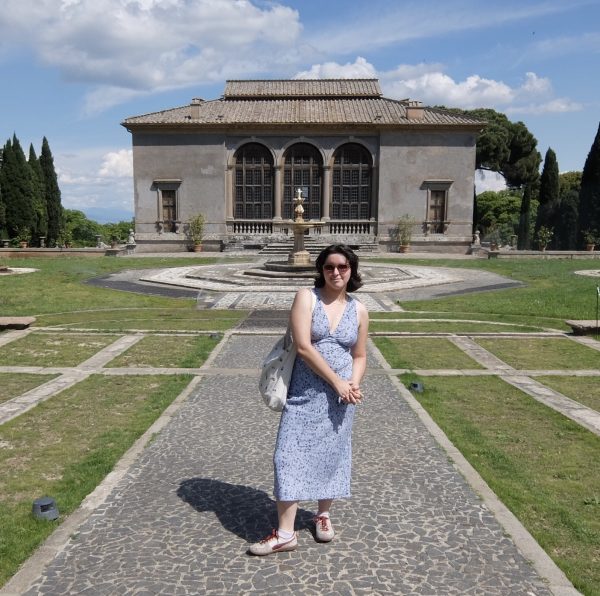
Zoe Roettger ’27, who explored the originally Etruscan city of Volterra (in the Tuscan region of Italy), focused on the historical alabaster trade. She initially heard about the fellowship last fall from Professor Bill North and was inspired to apply after attending the 2024 presentations. Initially unsure of where to go, Roettger spoke to professors.
“In Fall Term, when I was looking ahead to the Rome program, I asked one of the Classics professors, Cecilia Cozzi, if she had any suggestions as to where I should go in Italy to explore ancient elements. And she suggested Volterra,” Roettger said.
Once in the town, Roettger was first struck by the views: “It was my first time seeing the Tuscan landscape, and we managed to catch some truly stunning sunsets. Also, the alabaster works that I was looking at were incredible in terms of their craftsmanship and age.”
During her presentation, Roettger spoke about the many museums and sites that she visited and provided a complex portrait of Volterra and its modern reaction to and interpretation of the town’s conquest by the Medici in the medieval ages as based on her comprehensive experience.
Ella Parke ’27, who visited Otranto, also selected her project based on coursework while on campus.
“I determined where I wanted to go from Bill North’s Byzantine World class, where in a very short sentence in the novel ‘The Alexiad,’ Otranto was mentioned as being conquered by Robert Guiscard,” she said.
After making her decision, Parke began to research the town and learned about its significance. Her main site was the floor mosaic of the Otranto Cathedral, which drew on a variety of medieval sources from religious texts to legends from all over Europe, such as that of King Arthur.
“I did the bulk of my research on the floor mosaic and also on why the Ottomans saw Otranto as important to their conquests and what that meant about cultural identity and memory of conflict for present-day Italians,” Parke said.
During her presentation, Parke described several interactions with locals in Otranto, noting that the town lacks tourist destinations (aside from the cathedral) and so the locals primarily speak Italian. Otranto is located on the heel of the boot of Italy. She also described that the people of Otranto have significant local pride in the town’s historical role in blocking the Ottomans from entering the rest of Italy.
Hope Yu ’26 also did a Boyd-Niles fellowship in association with the Rome OCS program, journeying to the island of Sardinia to investigate the well of Santa Cristina, a Christian pilgrimage site. Yu’s presentation detailed her journey and the environment’s possible effects on worship in the medieval and modern ages. Both Parke and Yu emphasized the role of the culture of southern Italy’s small towns in their travel experiences; their interactions with locals were positive, but limited by language.
Finally, Austin Flamm ’27 detailed his experience visiting a number of churches and monasteries throughout Georgia and studying their architecture. He had participated in the Carleton program in Kazakhstan. Flamm’s research was conducted the summer after his OCS, another option popular among Boyd-Niles students. He chose to do a Boyd-Niles fellowship after this program because he wanted to compare his experience in Central Asia with the Southern Caucasus, stating, “I was interested if the relationship between national identity and religion differs between Georgia, Armenia, and Central Asia. Furthermore, as a Russian major, I was eager to investigate how Georgia, a former Soviet state in the Russophone world, has deployed Georgia’s rich orthodox tradition to construct a national identity.” He emphasized a comparison between the medieval and modern, and incorporated the interviews he had with several local monks into his presentation. He also explained several popular forms in medieval monastery architecture, and then showed images of the modernized versions.
Applications for Boyd-Niles fellowships happen each term and are due Nov. 3 for students planning Winter projects. History Professor Bill North, who sets up the application as the Medieval and Renaissance Studies (MARS) coordinator, noted that “the majority of applications have been [for students going on] Carleton OCS; we don’t restrict it but it may be that it’s more convenient for us to reach out to colleagues who are leading programs and say ‘there’s opportunities, please let your folks know,’ than other programs that do direct enrollment.” He explained that while two or three faculty readers make suggestions when the applicants submit their plans, it is relatively hands-off after that, although support is available to those who would like it. According to North, most of the critical feedback is logistical, suggesting adjustments on travel plans from a more experienced perspective.
The OCS research version of the fellowship has existed since 2017. While there were Boyd-Niles essay prizes before then, gradual changes in course offerings and structures meant that fewer assignments were allowing students to produce essays fitting the submission guidelines. Working in conjunction with the donor, North explained how the program was shifted to support students studying abroad. Of this particular round of presentations, Professor North commented, “This was a very good crowd, and that was nice to see. It was nice that some people who had gone on OCS programs and were there to support their friends… OCS programs build a cohort, and there’s support within the cohort.”
For students considering applying to the Boyd-Niles fellowship, Professor North advised, “MARS has really expanded its geographical scope, so we try and embrace the world so to speak. So you might not think, ‘oh MARS, I’m going to Japan,’ but… you could apply to the Boyd-Niles. Part of what we’re interested in doing through the travel fellowship is to suggest wherever you go, especially in parts of the world outside of the U.S., you could find a deeper layer of history, culture etc. to explore.”
Roettger said, “I would say go for it. It’s a great opportunity, and I probably wouldn’t have gone to Volterra and had this wonderful experience if not for the fellowship. I would also suggest looking at transportation more closely, as buses can be unreliable, and to splurge a little on accommodations, as that really affects how easily you can reach your sites of interest.” Flamm simply suggested, “Use this fellowship to go somewhere you otherwise might not have gone to!”