

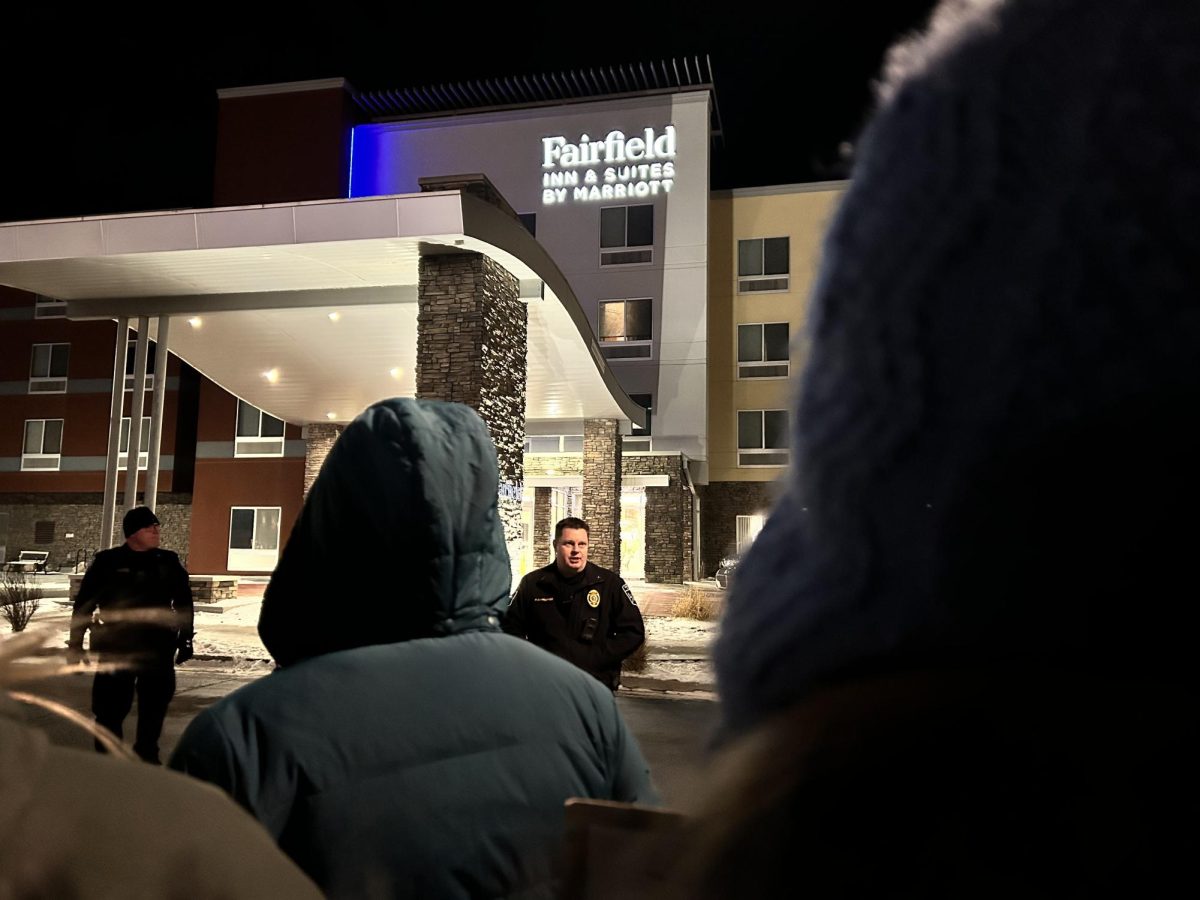
On Monday, Jan. 26, a group of Northfield community members and students from Carleton and St. Olaf Colleges gathered across the street from the Fairfield Inn & Suites with instruments, pots and pans, whistles and megaphones in response to reports that federal immigration officers had checked into the hotel earlier that day.
In an article published on Jan. 27 by KYMN Radio, Andy Beaham, the Fairfield Inn Director of Operations for Rebound Hospitality, confirmed that federal officers had checked into the hotel on Monday, although the specific federal agency the officers work for is not known. In the article, Beaham also states that the agents checked out of the hotel early on Tuesday, the morning after the late-night protest. A statement from the Northfield Police Department also states that the federal agents had checked out of the hotel.
On Monday afternoon into the evening, some Carleton students joined a group of Northfield residents picketing with signs outside of the hotel in protest. The Monday night demonstration drew a much larger group and was focused on disrupting the agents in the hotel with loud noise from outside. This tactic violated Northfield’s unlawful noise ordinance, leading to friction with local police.
According to a statement from the Northfield Police Department, “officers observed violations related to noise, public nuisance and disorderly conduct. Lawful dispersal orders were issued. When those orders were not followed, the gathering was declared an unlawful assembly, which ultimately resulted in an arrest.”
The arrested individual was handcuffed at 11:59 p.m., after most of the protesters had dissolved. They do not appear to be a Carleton community member.
A large portion of the late-night protesters were students from both Carleton and St. Olaf. Jonathan Martinez-Margarito ’28, a Carleton student who attended the protest, said that they felt the student participation sent an important message.
“It shows that we care about what happens in Northfield. I think, to some extent, there is this perception that Carleton and St. Olaf students are separate from Northfield, that we don’t really interact with them, that we’re our own little bubble. In reality, we contribute a lot to Northfield, and they contribute a lot to us. So, I think it should be noted that we need to interact with our community, and that also applies to protecting our community,” Martinez-Margarito said.
Northfield Police officers were already at the hotel when the demonstrators gathered at 11:00 p.m. Before the protest began, an officer gave the group a preliminary warning about Northfield’s unlawful noise ordinance, mentioning that protesters could be arrested if they used noise amplifiers such as instruments or speakers. While Martinez-Margarito said that police presence always creates some discomfort, he mentioned that the officers at Monday’s protest seemed generally nonthreatening.
After the warning, the group of demonstrators began chanting and, eventually, using megaphones, playing instruments, blowing whistles and banging on cookware.
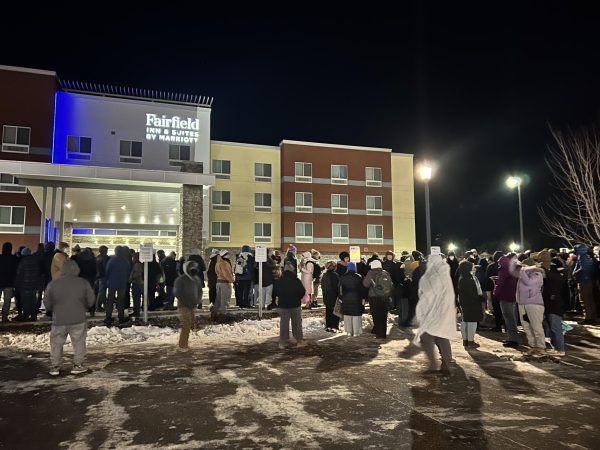
At 11:33 p.m., one of the leaders of the demonstration who had been communicating with Northfield Police, used a megaphone to advise protestors that the police were particularly concerned with protesters who were using instruments, motioning that the group “stick with [their] voices for now” to avoid arrest.
The majority of the gathered protesters returned to loudly chanting, but some sporadically continued to use noise amplifiers. One protester yelled out, “Do they have enough handcuffs for all of us? If you have your instrument, I suggest you use it.”
At 11:42 p.m., Carleton’s Vice President for Student Life and Dean of Students Carolyn Livingston spoke to the protestors using the Northfield police car’s speaker. Livingston informed students that the police told her they would give three more rapid warnings before students would need to disperse. She added that there were police cars stationed around, saying that, “they’re going to do what they have to do.” Livingston mentioned that she was not speaking on behalf of the police department, but “on behalf of the Dean of Students” and as a concerned member of the Carleton community.
While Livingston spoke, some students and demonstrators in the audience whistled and jeered. Martinez-Margarito said that Livingston’s presence at the late-night protest was confusing.
“It was very bad optics of her to use police equipment and to go into the hotel after she was done addressing us,” Martinez-Margarito said.
At 11:54 p.m., after three more warnings, a police officer told the demonstrators that “this is now considered an unlawful assembly,” ordering the protesters to disperse or risk arrest. At this point, many of the gathered protesters dispersed, though some stayed outside the hotel or began chanting on a nearby bridge for several more minutes. The arrest took place after most of these remaining protesters had dispersed.
While handcuffed, the arrested individual gave one of the leaders of the demonstration a phone number to contact, asking that he “tell her that these [police officers] are standing with ICE, and they’re defending ICE, and I got arrested doing what the f— I came out here to do.”
Monday’s protest followed a turbulent several days on campus and in Minnesota at large. On Friday, many Carleton community members participated in marches and strikes as a part of a state-wide “Day of Truth & Freedom” protest. Many professors canceled classes, and many students who did have classes skipped class in accordance with the protest. Several Carleton students also attended marches in Northfield and in Minneapolis.
“Professors canceling classes and making class optional did in no way push me to go [to the Minneapolis protest], but it pushed me to think about going and very much lessened the barrier to entry,” said an anonymous junior who attended the protest in Minneapolis on Friday.
As with the noise protest on Monday night, Northfield residents and college students collaborated in protest efforts on Friday. The junior prepared for the protest with help from community members who met beforehand at the Raven’s Nest Cafe. The junior, as well as an interviewed sophomore who asked to remain anonymous, were driven to and from the protest by different Northfield residents who volunteered to shuttle students.
The sophomore said that Friday’s march was her first time ever attending a protest, mentioning that, as a person of color, she was initially worried about attending. However, once the march began and the sophomore began chanting with the crowd, she was thankful to have gone.
“It felt like my actions actually mattered,” the sophomore said.
The junior also felt thankful after attending the Minneapolis protest.
“It is moving to feel that one is a part of a greater whole, and I would say that the world makes more sense when you experience it with your body and your eyes than when you read about it online… It is easier to feel empathy and hope when you can look someone in the eye and when you feel like you are a part of something larger. There is something about the way that words ripple across a crowd,” the junior said.
On Jan. 24, the day after the statewide protests, Alex Pretti was shot and killed by a federal agent involved in the immigration crackdown in Minnesota. Also on Saturday, a large number of ICE officers were spotted in Northfield, causing alarm among residents and students. An individual was reportedly detained by ICE officers at 2nd Street and Division Street, but specifics of this alleged situation have not been made official. Campus was locked down, requiring a OneCard to access all buildings, and several emails were sent from the administration to the entire Carleton community explaining that ICE presence had been reported near or on campus.
Both the killing of Pretti and the increased ICE activity on Saturday spurred organizing efforts in the Northfield and campus community, leading up to the noise protest on Monday night. The sophomore said that Saturday’s events made her even more sure of her decision to attend the march in Minneapolis the previous day.
“[After Saturday’s events], I knew I made the right choice [attending Friday’s protest]” said the sophomore. “I felt good that I had done something, even if it was just holding a sign.”
Martinez-Margarito also spoke about the uplifting possibilities of participating in protest and mutual aid. He mentioned that there are several ways to get involved in further activism on campus by reaching out to organizing groups.
“There’s always something to do,” Martinez-Margarito said.