
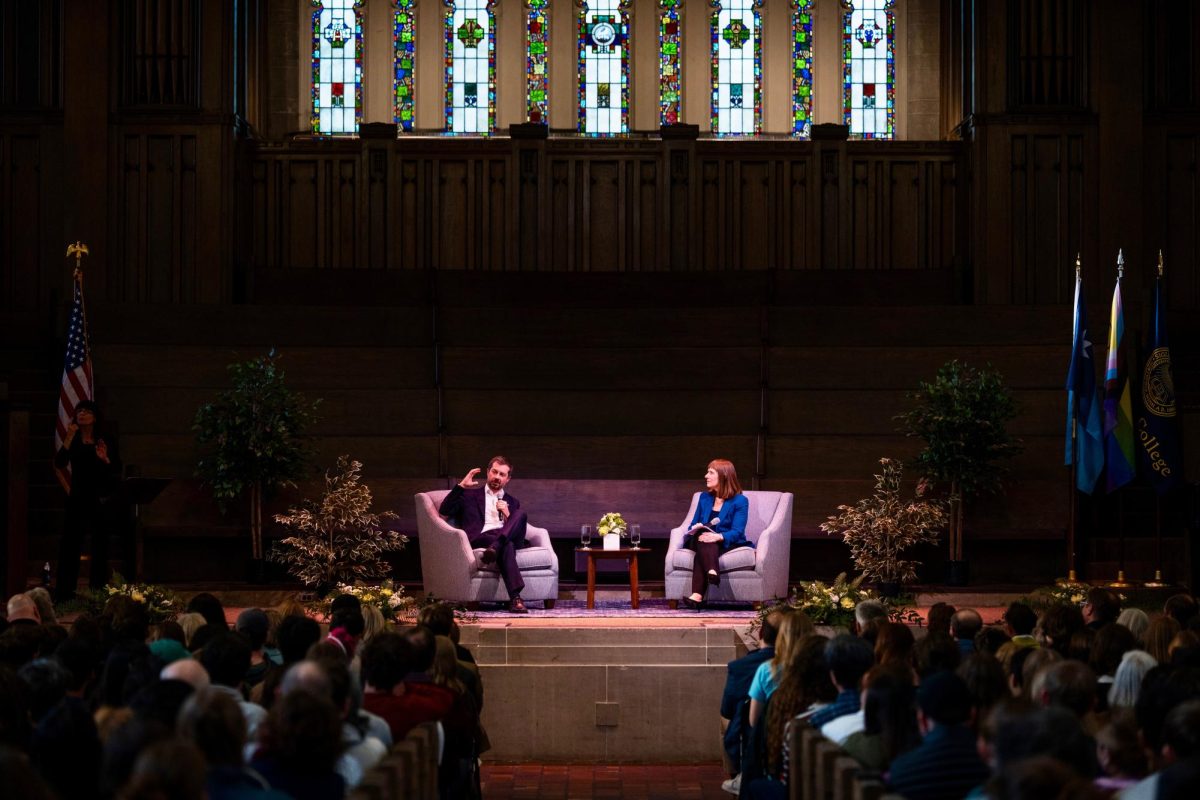
On Tuesday, April 28, former U.S. Secretary of Transportation Pete Buttigieg spoke at Carleton College as part of a new lecture series entitled “Engaging Across Viewpoints,” which is funded by a Carleton alumnus to foster dialogue and encourage intellectual curiosity. In-person attendance was limited to 900 people, and additional rows of chairs were added at the front of Skinner Memorial Chapel to accommodate all ticketed spectators.College President Alison Byerly facilitated the first part of the event, during which she asked Buttigieg a series of questions. Her questions covered a wide range of topics from his stances on domestic and international issues to the future of democracy to Buttigieg’s personal political aspirations. Afterward, several students, faculty and staff asked Buttigieg pre-selected and screened questions about issues relevant to their own lives and fields of interest.
Byerly introduced Buttigieg by highlighting his undergraduate education at Harvard College, where he majored in literature and history, and then he obtained his Rhodes Scholarship at Oxford University. She also reviewed Buttigieg’s more widely known background: his previous service in the United States Navy; his tenure as Mayor of South Bend, IN; his position as Secretary of Transportation under Former President Joe Biden; and his 2020 campaign for Democratic presidential nomination.
After the introduction, Buttigieg said that he has always “thought very highly of Carleton… I had an English teacher who was an alum, and she never let us forget it.”
Byerly began by asking about Buttigieg’s reaction to Operation Metro Surge, an effort by President Donald Trump’s administration to apprehend undocumented persons by sending thousands of federal Immigration and Customs Enforcement (ICE) agents to cities and towns across Minnesota, including Northfield and the Twin Cities. Buttigieg explained that, for him, Trump and the Department of Homeland Security’s (DHS) actions in Minnesota are indicative of a “totalizing ideology of control coming out of this administration,” and run counter to all forms of “independence” in American life.
“This should be profoundly offensive to any freedom-loving American: left, right or center,” said Buttigieg.
Byerly then posited a question regarding the border and the restrictive policies that the Trump administration has strongly endorsed. Buttigieg explained that while “every country has borders,” he strongly opposes the way President Trump has handled border policy. “Walls have to have doors, fences have to have gates.”
Byerly also asked about Buttigieg’s many appearances on Fox News, considering the channel’s reputation as a conservative platform. She pointed out that his appearances are unique among Democratic politicians, especially in an era of strong political polarization. Buttigieg began his answer with an acknowledgment of how, for most citizens, particularly young individuals like the students that filled the chapel, “get a lot of our information from our [social media] feed.”
He proceeded to discuss the harm that comes from an algorithmic system tailored to the likes and dislikes of whoever is scrolling. Buttigieg finds that his appearances on Fox News allow him to reach an audience that most likely wouldn’t see him otherwise and joked to his majority Generation Z audience, “I can’t believe I’m romanticizing cable.”
Buttigieg added, “I can’t blame somebody for not embracing a viewpoint I hold if they’ve never heard it.” He also urged people to engage in discourse across party lines like he does on Fox News, saying that “we need to create more spaces where that still happens… the best places for that are offline.”
With the United States entering deeper into military conflict with Iran and ramping up military strikes against Lebanon-based group Hezbollah, Byerly asked Buttigieg his perspective on the role of Israel in foreign policy. She noted that as Buttigieg’s political career has developed, his public opinions and endorsement of policy surrounding Israel and the United States’s role in Israeli military conflict have changed.
Buttigieg said that though he cares deeply about the safety of Israeli people as well as Jewish people around the world, he also cares about the human rights and recognition of Palestinian people. He said that “the war in Iran is making it even worse as it makes everything worse,” and said that “the clear reality… is that Americans cannot… be sure that their tax dollars are being used… in accordance with American law.”
Conflict in the Middle East continues to be a controversial topic on Carleton’s campus, with Students for Justice Palestine (SJP) chalking the sidewalks around the Chapel and protesting outside the event, as well as in the political world writ large.
Kumail Akram ’29, who attended a debrief session hosted by CarlDems after the event, said “there was a deliberate attempt on his part not to sidestep the issue, and I appreciate that.”
After about forty minutes, Byerly transitioned from the role of inquirer to moderator, allowing students, staff and faculty to ask their questions.
Aiden Johnson ’27 asked Buttigieg about his view on the role of Artificial Intelligence (AI) in the future of technological innovation and the job market. Buttigieg, drawing on his experience at the Department of Transportation, spoke about how innovations in transportation technology, from airplanes to self-driving cars, can make travel safer.
The problem with high-profile technological innovations, according to Buttigieg, is that while technological advancements could make way for “shorter workweeks and more money in people’s pockets,” they can also be weaponized, leading to exacerbated wealth inequality. Buttigieg said that when one considers the evolution of tasks and jobs that AI could potentially bring about, one needs to recognize that jobs often constitute a good portion of a person’s identity. Additionally, in order to effectively deal with major job market changes, society must build sources of belonging beyond work; Buttigieg proposed strong community networks, service opportunities and faith organizations as examples.
Carleton Aerobics Instructor Lindsay Ness asked about the future of democracy in the U.S., questioning the government’s reliability if a single election can significantly alter trust and capability. Buttigieg admitted that other countries are “shaken by what they are seeing from the U.S.” and that restoring trust would take time and humility from future U.S. leaders.
However, Buttigieg offered a message of guidance and hope, saying, “it’s not anti-American to come to terms with the problems we have had as a country.”
“I wouldn’t be doing what I do if I didn’t believe it was possible… to build to a better future than what we’ve got,” he said.
He continued to reflect, adding that much of what drives his work is the pursuit of this “better future” for his four-year-old twins and future generations alike. Buttigieg added that, if Americans continue to fight for their beliefs and values, “we could one day be proud of the 2020s.”