
This fall, the Spanish and French departments expanded their Language Associate (LA) and Teaching Associate (TA) training to include the College Reading and Learning Association (CRLA) level one certification. The first cohort of students received their Level 1 CRLA certification in March, and students who continue working in the program in future years will have the opportunity to work towards upper-level certifications.
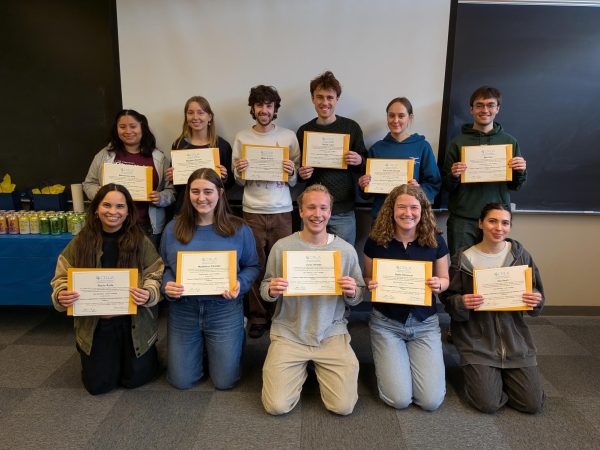
Second row: Maricarmen Arce ’27, Margaret Benson ’26, Mateo Bustos (LA), Charlie Cullen ’27, Ella Curtis-Revelle ’26, Ben Ellis ’26
Not pictured: Emilia Arabia ’28, David Fulguera ’26, Max Kingston ’26, Roy Llewellyn ’26, José Ramírez Dorantes ’27
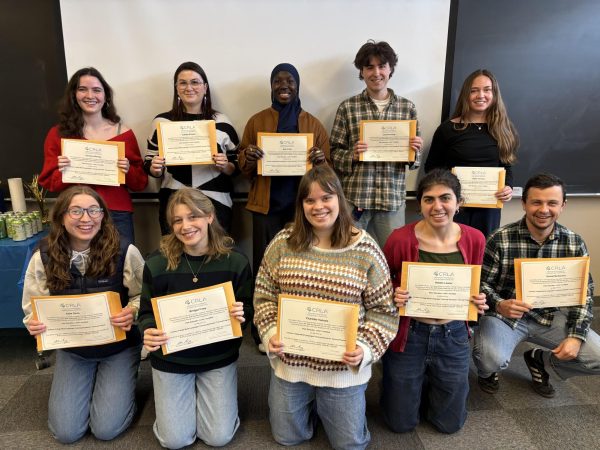
2nd row, left to right: Caroline Berkey ’28, Calixte Bintein (LA), Awa Cisse ’27, Jack Gronholz ’26, Stella Johnson ’27
Not pictured: Laurine Kim ’26, Grace Schwarz ’27
Spanish Program Director and Senior Lecturer Vera Coleman and Lecturer in French and coordinator for a segment of the French program, Sarah Anthony, began working toward aligning their programs with CRLA standards late last school year when Anthony attended a seminar about CRLA. The two then received the 2025 Curricular Innovation Grant from the Provost’s Office as well as funding from their respective departments, enabling them to update training materials over the summer.
The two hoped that this credential could help to recognize the hard work that their TAs were already putting in. “We were already doing quite a lot of training here, and one of the thoughts was that we wanted the TAs to get credentials for the training, to give it some weight here at Carleton,” said Anthony.
Initially, they explored a variety of options to give a credential to the TAs, including creating a certification specific to their departments; however, as Coleman said, “we had considered what it would mean to create some sort of certification specific to just Carleton, but we wanted it to be relevant outside the context of the institution, to meet certain standards in peer-assisted learning.” She added that the CRLA certification is rather rigorous, requiring not just the completion of a set of training modules but also 25 hours of student contact to be eligible for each level.
Director of the Language Center Amy Hutchinson echoed a similar sentiment and explained, “We live in a very credential-driven society now, so having that on their CV is huge.” She added that it could be particularly valuable when pursuing post-graduate opportunities such as the Fulbright or Watson fellowships, which provide funding for research and work outside of the United States.
While Carleton has a number of peer educator opportunities, including TAing or prefecting for a number of departments, Anthony noted that “a TA program at an undergraduate level is really quite rare; it’s very unique, typically this happens at a graduate level. So the fact that they’re getting the teaching experience here and also getting this certificate is great for anyone who’s thinking of teaching in some capacity.”
CRLA does not provide a specific curriculum required for the training, but rather provides a set of guidelines and standards that must be followed for each level of the certification.
Coleman said, “In something like working with specific populations, we could decide what does that mean for Carleton? So [in the module] we look at the specific data for the student body makeup at Carleton, and then focus on supporting first-generation students.”
Across the 20 modules that make up the training, Coleman and Hutchinson heavily revamped six and created four new ones. They focused on areas such as race, class, power and privilege, universal design for learning and accessibility in world language learning, intercultural communication, working with specific populations, assessing and/or changing study behavior and critical thinking skills. Anthony and Coleman highlighted the ways in which the CRLA framework has helped them to integrate themes of inclusion, diversity and equity (IDE) throughout the entire training.
Amelia Lawlor ’26 worked with Anthony and Coleman throughout the fall in creating some of this instructional material, primarily on modules focused on critical thinking and universal design for learning. Lawlor explained, “They outlined the key goals and topics they wanted to include in the training, and I researched those areas and translated what I found into clear, structured teaching resources.”
Through this focused work on the training, Anthony reflected, “It really brought the level of the TA program up, in many ways.”
French LA Calixte Bintein received the certification after completing training throughout the year. She emphasized the importance of learning interpersonal skills in the classroom, and noted the training helped her think through “If there is ever a problem, if there is ever an issue, what do you do and how do you act and react to that?”
Bintein highlighted the value of these people skills in language learning and creating a comfortable classroom environment. She explained, “Language learning is highly sensitive learning. It’s vulnerable: you don’t speak the language, you’re just learning, and then in front of you is someone who already speaks the language, so sometimes it can be a really vulnerable space.”
Lawlor, who also received the certification as a part of her role as a French TA, emphasized the utility of learning about different teaching strategies she could use during her sessions and practicing applying them to case studies. She elaborated, “This made the training feel a lot more practical and relevant towards what we actually do as TAs, since it was less theoretical and more geared towards implementing these theories in the classroom through concrete strategies.”
Spanish TA Maricarmen Arce ’27 echoed similar sentiments on the increased practicality of the trading. Reflecting on it in comparison with what she experienced in years past, she explained, “I have been a TA since my first year at Carleton, and I do strongly believe that I have grown a lot this year through the training.” Arce emphasized the flexibility of the content, making it applicable to students in the language sequence, courses 101, 102 and 103, as well as to more advanced learners in 204 and 205.
Hutchinson highlighted the CRLA’s role in helping to standardize the training experience, and hopefully the classroom experience as well. She explained, “So from now on, it’s my understanding that these tutors will always be trained the exact same way. So that means that no matter the section of Spanish 101 you’re in, you will have the same experience.”
Coleman and Anthony hope that the certification will also encourage TAs to stay in their positions for several years, especially with the added incentive of opportunities for level two certification. They also noted the importance of multi-year TAs in helping to train new hires each year.
As for the future of the certification, Hutchinson hopes to expand the program to cover all seven of the LAs, not just the Spanish and French LAs who received training alongside their respective TAs.
Reflecting on the process, Coleman and Anthony focused on the centrality of collaboration, both with each other, with TAs and with other campus offices such as the Academic Support Center, Language Center, Dean of Students, Information Technology Services and Office of the Provost.
Anthony shared, “Personally, I’ve enjoyed collaborating with another supervisor and TA program director. I feel I’ve learned a lot through those exchanges.” Coleman echoed the sentiment, and said, “I have learned more ways to collaborate with the TAs on the trainings. Returning TAs are such a wealth of experience, of knowledge and of insight into what it is really like to be a TA. And we see it from the outside, but our experience is different.”