

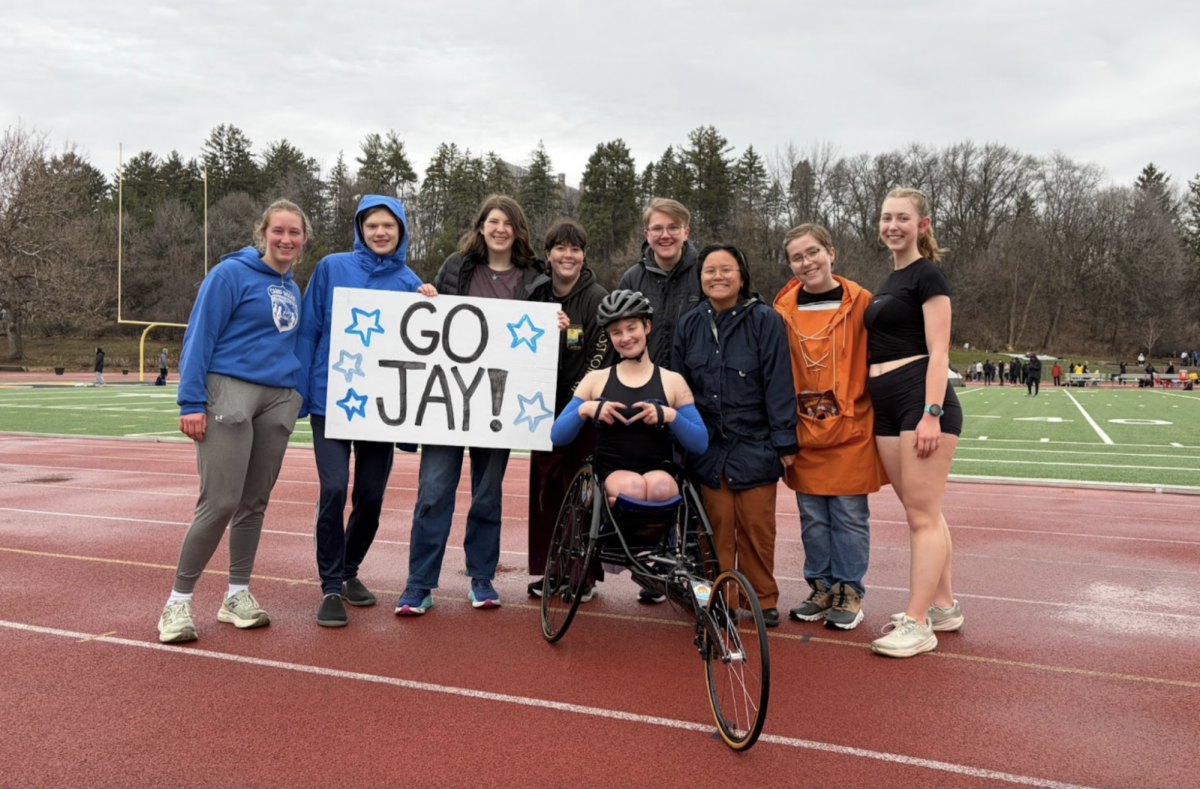
The track meet on Saturday, April 11 was wet. The rain had been coming down before the meet began, ebbing and flowing throughout the day. In combination with the low 50s temperatures and wind gusts of up to 26 mph, heavy waterproof coats and umbrellas were the fashion of the day.
Among the schools being hosted at St. Olaf’s Klein Field at Manitou was Carleton, who had set up their tents just next to the bleachers. The blue tent with yellow lettering was positioned under several pine trees in an attempt to hide from the rain. Elevated slightly on a small hill, the tent faced the parking on one side and the red synthetic track on the other. A tarp on the ground kept students and their belongings dryer than they would have been otherwise. By the time I arrived, around 10:20 in the morning, throwing events and runners’ warmups had already begun.
One Carleton student, however, was not preparing for the day’s events with the rest of their classmates. Jay Coleman ’29 arrived separately from the Carleton delegation and they paid their own $25 entrance fee to race as an unaffiliated athlete.
For most of their life, Coleman was an able-bodied track and soccer athlete. They started participating in adaptive sports in their junior year of high school, going fully adaptive the following year. Presently, Coleman is a paratrack athlete and Carleton student. This past Saturday, they set a personal best in the wheelchair 400m of one minute, twenty-two seconds. They raced alone, making sure not to wear the Carleton-specific shades of blue or yellow that stood out among the crowds of athletes, coaches, and spectators.
“I’d love to be able to race for Carleton, to be able to represent my school,” Coleman said in an interview conducted a few days after their Saturday race. “People think of track as an individual sport, but the truth is it’s really about your team: who you’re practicing with, who’s there for you on the sidelines cheering for you, who’s giving you encouragement as you’re pushing as hard as you can.”
Despite being alone in their heat race on Saturday, Coleman is not alone in their fight to race under Carleton’s banner. Almost a dozen of Coleman’s classmates showed up to Saturday’s meet, specifically to watch Coleman race. One student brought a large, hand-painted sign reading “GO JAY!” in black lettering with blue stars around the supporting message. Another student was managing snacks for the group, including some that were sent along by friends who were unable to make it to the race. The group coordinated videography, photography and even cheers, making sure their friend could hear them the whole way around the track. Athletes for Carleton’s track team were out in support too, celebrating Coleman at the finish line.
“Everyone is awesome, they’re super kind and super interested in allowing me to be part of the team,” Coleman said.
That support is valuable as Coleman takes a road less traveled. The Minnesota Intercollegiate Athletic Conference (MIAC) and National Collegiate Athletics Association (NCAA) DIII Track and Field have no existing structure for paratrack. The introduction of a paratrack program would mark a new step at the DIII level. It would follow in the steps taken between the United States Olympic and Paralympic Committee (USOPC) and the NCAA in 2021, with the introduction of the Para-College Inclusion Project. Currently, USOPC’s website lists only six schools as having para-track and field teams, all of which are within the DI division.
Introduction of such a program or support of such an athlete would be a major step for the small and progress-minded schools that find home in these conferences.
Coleman has worked with multiple departments on campus, including Physical Education, Athletics, and Recreation (PEAR) and Office of Accessibility Resources (OAR), but has yet to find a permanent solution. They described a complicated back-and-forth process, but noted the willingness of most people they’ve worked with.
“Everyone at PEAR, they’re very enthusiastic, which I love. I understand that it’s a tricky place to be in, because this is unprecedented. It’s hard for them to be fully supportive, just off the bat when there are so many things we need to work through, but everyone’s being really, really kind about it.”
Trying to race under the Carleton banner isn’t the only path Coleman is using to spread awareness. They’ve also utilized social media, sharing their struggles and wins while forming connections in the process.
“I’ve been trying to talk about my journey on social media a little bit. And I will get kids from other teams who come up to me at races and be like, ‘Hey, I’ve seen what you’re doing, and I just want you to know that this is awesome,’ and it’s just really, really, really sweet,” Coleman said.
At the end of our interview, Coleman paused to pull up an email they received after Saturday’s race from Leon Lunder, former athletics director at Carleton. The supportive message, calling Coleman a “difference-maker,” brought a wide smile to their face.
“It just made me really, really happy.”