
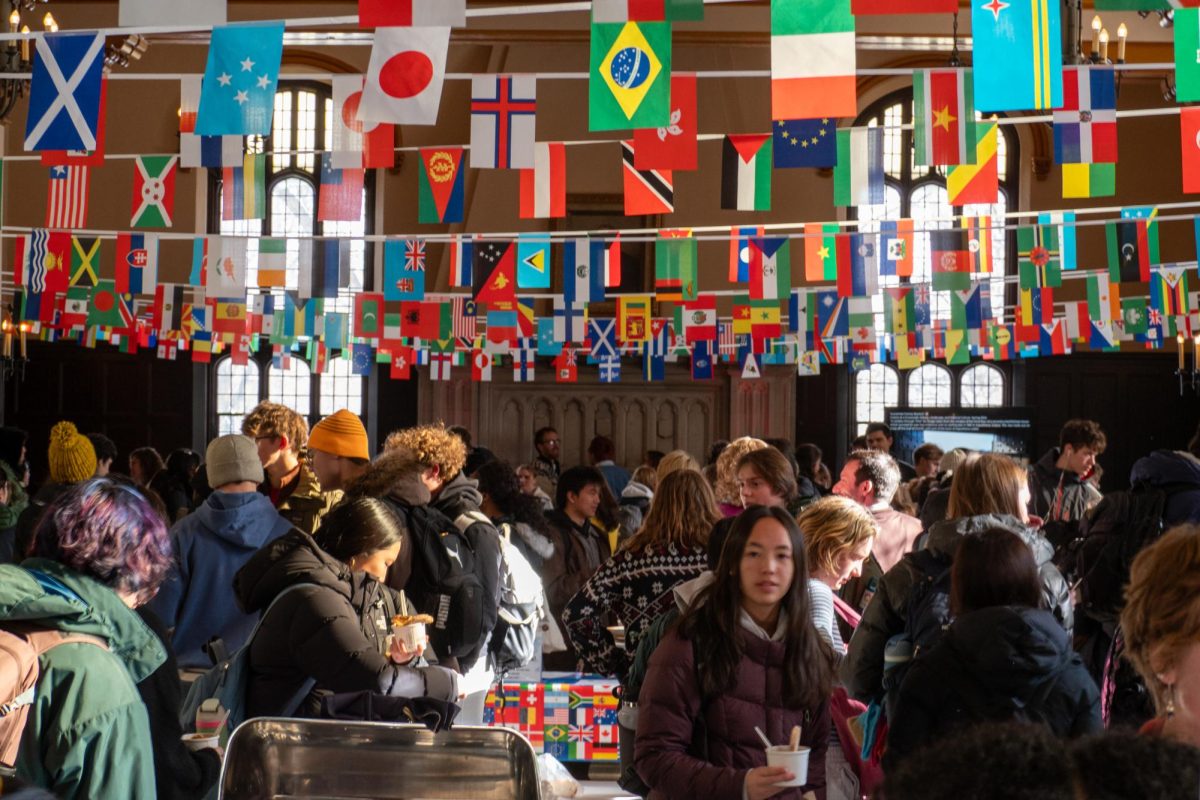
On Thursday, Jan. 22, the Off-Campus Studies Office (OCS) hosted its annual World’s Fair, an event designed to help students explore their OCS options and talk with others who have attended various programs. Helena Kaufman, Director of Off Campus Studies, shared that over 200 students attended, with around 100 programs represented, including programs run by Carleton faculty and non-Carleton programs.
For many Carleton students, the idea of studying off campus can feel both thrilling and overwhelming. With dozens of programs spanning continents, academic disciplines and time commitments, OCS represents one of the most expansive opportunities Carleton offers and can be one of the most daunting to navigate.
Held during the winter term, the OCS World’s Fair gave students the chance to explore what studying off campus could look like for them, whether they are just beginning to think about the possibility or are already narrowing down specific programs. According to Kaufman, the World’s Fair has been occurring since before she began at Carleton, over 25 years ago. It was initially a nighttime event, often featuring performances and live music. Over the years, however, the Office noticed that attendance was declining and opted to move the event to the daytime in the mid 2000s. With the establishment of Common Time, the midday window became an even more opportune time to reach as many students as possible.
The majority of programs at the fair are represented by student volunteers. Kaufman noted the opportunity to share about their program can help returning students to reflect on their experience after some time to readjust to life at Carleton. As Zoe Roettger ’27, an OCS fellow, explained, “I would say that the main goal of the OCS fair is to introduce program decisions all at once in a more in-person way.” Rather than relying solely on advising appointments, websites, or flyers, the fair creates an environment where students can ask questions face-to-face and hear directly from peers who have already gone abroad or studied off campus.
Carleton has long had a strong OCS program with 62% of the class of 2024 choosing to study abroad for at least one term. About 60% of students typically attend Carleton-led trips compared with 40% attending non-Carleton trips. During COVID, with travel restrictions and quarantines, the number of students studying abroad decreased sharply. According to Kaufman, it has taken several years for these numbers to recover as countries reopened their borders and eased restrictions at varying rates. This fall, however, about 200 students studied abroad, more than did so pre-pandemic in 2019. Kaufman expects this trend to continue.
Notably, a change from 2019 to 2026 is the number of students choosing to study in Europe rather than in what Kaufman described as the Global South, including South America, Africa, and Asia. Currently, across the study abroad industry, about 64% of students go to Europe. This trend represents a broader shift in the study abroad landscape, with programs with many locations considering whether to shift resources towards expanding their European options.
Kaufman speculated that this trend might be an after effect of COVID, as many European countries reopened their borders more swiftly, primarily based on vaccine access.
Considering the future of programs at Carleton, Kaufman plans to keep working to address the question of “how do we make sure that students have experiences in different parts of the world?” In the 2026-2027 school year, Carleton will offer seven term-long trips to Europe, compared with 6 programs to the other continents, two of which take place inside the United States.
The current geopolitical landscape has begun to have effects on OCS, as well. Kaufman cited concerns from international students about being able to safely re-enter the United States if they choose to leave it. Previously, the rate of international students going on OCS nearly matched the rate of domestic students. Emilia Arabia ’28, an international student from Colombia who plans to study abroad in the spring, said, “By studying abroad, I think students, both domestic and international, can gain important knowledge about the places they go to that goes beyond the travel itself and helps their learning when they come back.”
Thus far, Kaufman said that Carleton has not had any students face issues re-entering the country, but noted that international students should be sure to check with International Student Life about their specific situation and Visa requirements.
As far as adjusting program operations, Kaufman explained, “As we look at the programming in different parts of the world, we always look at, of course, safety, security, whether we have enough of an emergency network to operate, but also, is the situation limiting the kinds of activities that we can have, that we can include in our program?”
Maddie Selinger ’28, who attended the Carleton Global Engagement program for ecology and anthropology in Tanzania, shared that the program ended around five days early due to political unrest. Earlier in the program, students had to stay on the host campus for around two weeks due to protests after the October general elections. In spite of this, students were still able to attend homestays and have an immersive educational experience. Selinger noted, “Getting to learn Swahili, speaking the local language and being able to interact with people in that way was very cool and really improved the experience a lot and allowed all of us to connect with Tanzanians better.”
Flexibility is a key message organizers the OCS Office hopes students take away from the World’s Fair. Jess Knachel ’27, who works with OCS and helped organize the event, emphasized the importance of understanding the wide range of options available. “I would say know your options,” he said. “There are so many different kinds of programs out there for students with different goals.” While a ten-week international Carleton program may appeal to some students, others may prefer shorter or longer stays, language immersions, homestays, or domestic programs. “I think most people can find something that appeals to them,” Knachel added.
One of the hopes for the World’s Fair, he explained, is that students walk away feeling energized about OCS and confident that “there is a community of people at Carleton ready to help them get where they want to go.”
He adds that the fair incorporates interactive elements designed to draw students in and spark curiosity. This year, Knachel designed a GeoGuessr-style game using photos from Carleton’s database of student images submitted in previous photo contests. The game challenged attendees to identify the country shown in each image. “I created the GeoGuessr game,” Knachel said. “It was fun to look through our database of student photos from previous years’ photo contests, and to see how people at the fair puzzled out what country they were looking at.”
Roettger attended two back to back Carleton-led OCS programs to Europe, Living London and the Medieval Renaissance Program in Rome. During the spring break between programs, she traveled independently with a friend, highlighting how OCS experiences can be adapted to students’ interests and goals. Reflecting on her return to campus, she noted, “By the time I got back, I was really excited to go back home.”
The immersion Roettger experienced had a direct impact on her learning. “It made the subjects that I was learning feel a lot more real because we were learning them in context,” Roettger said. Beyond academics, she noted the personal confidence she gained through navigating new cities, cultures, and routines. “My personal confidence really increased,” she said, adding that studying off campus also provided opportunities for exploration and connection: “You get to explore the world. You see new things, you meet, you make new friends.”
For students who were unable to attend the World’s Fair, OCS staff stress that the event is just one part of a larger advising process. Knachel encouraged students to continue exploring their options even if they missed the fair. “If you missed the World’s Fair, schedule an advising appointment in the OCS office,” he said, emphasizing that personalized guidance is always available.
Ultimately, the OCS World’s Fair is about more than applications or logistics. It is about helping students imagine themselves beyond Carleton’s campus and recognize that studying off campus is both achievable and supported.